PerforMind
LET'S OPTIMISE YOUR ATHLETES' COGNITIVE TRAINING TOGETHER
Let's talk about your organization and your goals. Our team supports you from A to Z. Enjoy a free one-month trial.
Our method combines standardised cognitive assessment and virtual reality training to build a tailored protocol, tracked and adjusted over time.
A continuous protocol, from initial assessment to long-term adjustment.
Standardised cognitive assessment across 10 work domains. A precise profile before any recommendation.
From the profile, our protocol generator lets you target the exercises to prioritise for your athlete's training sessions.
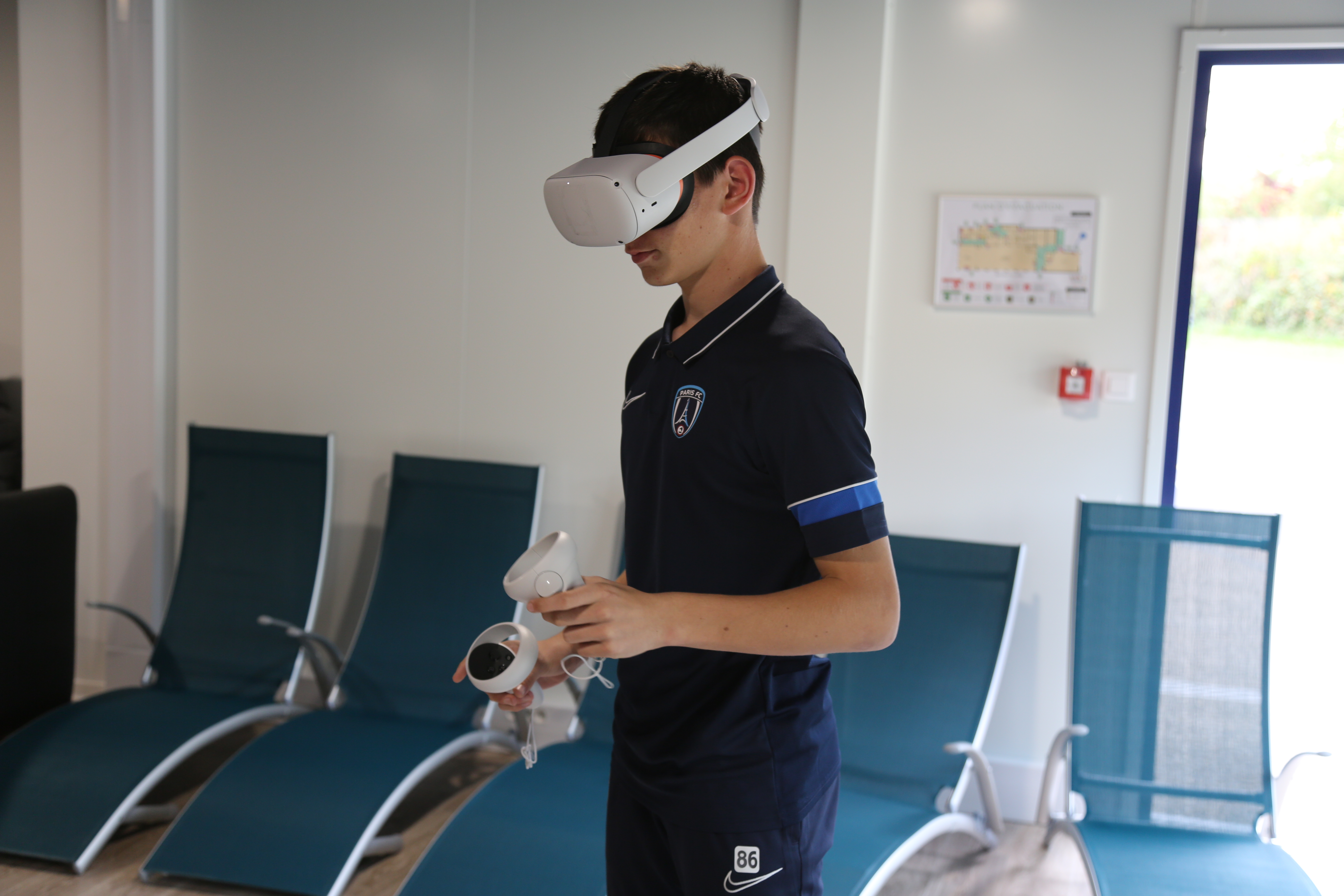
The athlete trains immersed in calibrated cognitive-motor exercises, alone or coached.
Every session feeds the statistical tracking platform, available to the athlete and their coach in real time.
Periodic re-assessment and protocol adjustment to maintain steady progress over time.
Our exercises target 10 priority cognitive work domains in sports practice. Each session engages several of them, under conditions close to real play.
The brain's ability to process multiple pieces of information and then choose one of them before acting (for example: right or left, power or lob, etc.).
The ability to adapt our behavior and thinking in the face of changing situations (e.g., analyzing and making a decision simultaneously).
The ability to concentrate on an activity or stimulus over a long period of time.
The ability to interrupt an action in progress (for example: stopping one's movement during a feint).
The time taken by the subject to suppress irrelevant information that disrupts the successful completion of the current action (e.g., time taken to pass to the right with the right foot or hand minus the time taken to pass to the right with the left foot or hand).
The time it takes the brain to process information after making a mistake.
The time it takes the brain to process information before acting (for example: hitting, shooting, jumping, etc.).
The ability to ignore irrelevant information in order to focus entirely on important information.
The ability to actively seek out important information from our environment, quickly and efficiently. Speed of gesture and movement.
A form of short-term memory that allows information to be stored and manipulated for a short period of time (a few seconds) in order to use it to accomplish a task.
Let's talk about your organization and your goals. Our team supports you from A to Z. Enjoy a free one-month trial.