SCIENCE

A solution rooted in research

Since its founding, PerforMind has built its tools in consultation with the scientific community, turning empirically-practised cognitive exercises into measured, validated and reproducible protocols.

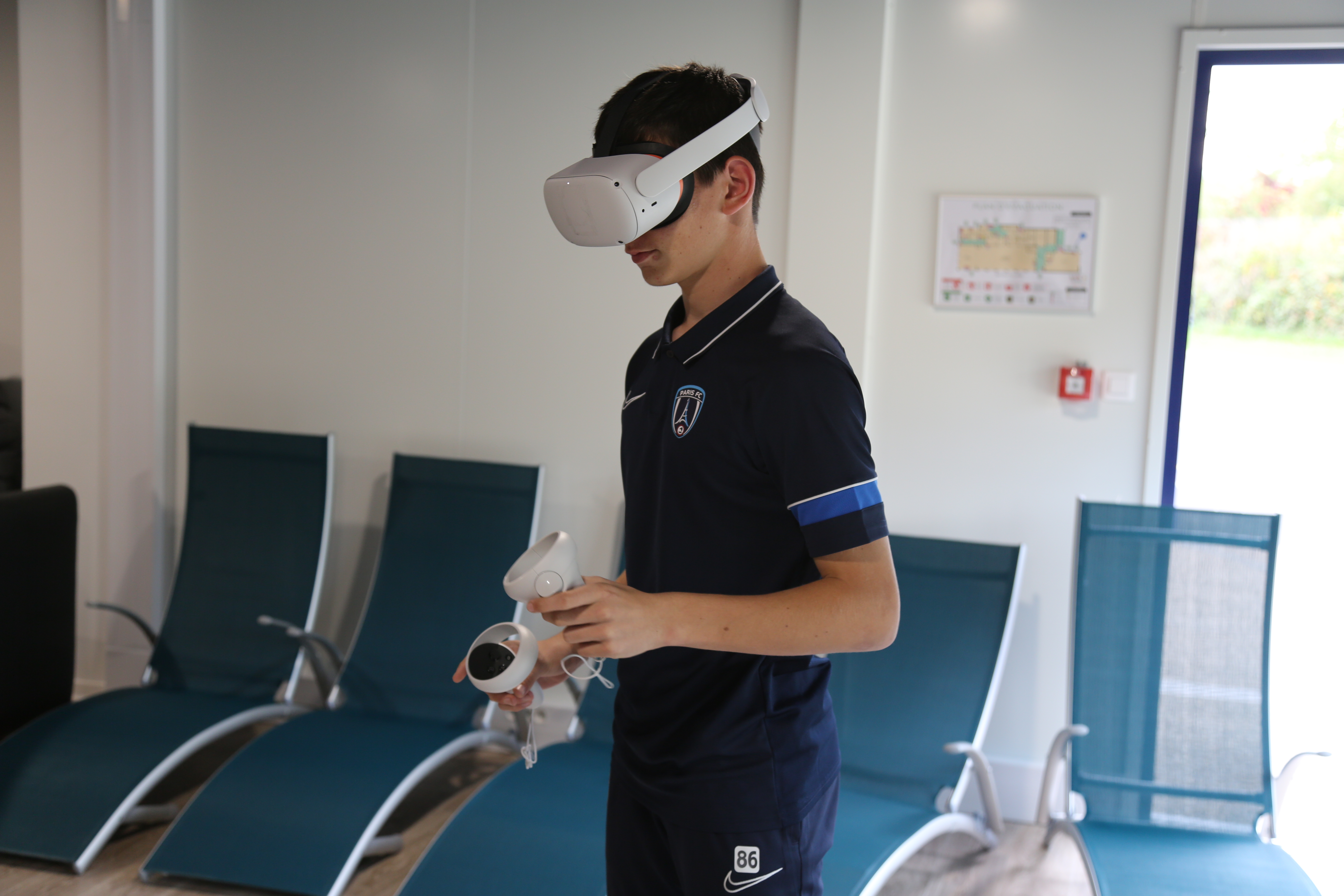
Our cognitive workshops in virtual reality are adapted from existing exercises

Our goal: to provide precise, quantified data that these exercises, practised empirically, did not previously allow us to obtain.

CO-DESIGN

University of Lille

Co-design of our cognitive assessment protocol based on standardised exercises from the scientific literature. Study conducted on a representative multi-sport panel of male and female athletes.

CLINICAL STUDY

CERS Capbreton

Study conducted on shoulder rehabilitation protocols 60 days post-surgery. The cohort consisted of 60 individuals, comprising a control group and a group using the solution.

FINANCIAL SUPPORT

Région Nouvelle-Aquitaine

Financial support from the region after being selected for the UNITEC-SPORTEC program. Our first prototypes were developed thanks to a partnership established with the PAU FC club.

ACADEMIC PARTNERSHIP

EPFL

Research partnership to validate and evolve our virtual reality cognitive training protocols.

Our consultants

Experts who guarantee the clinical and scientific rigour of every PerforMind protocol.

Scientific bibliography

The research work our protocols are based on.
Conflict resolution in the Eriksen flanker task: Similarities and differences to the Simon task
Hübner, R., & Töbel, L. (2019) · PloS one, 14(3)
Action video game training reduces the Simon Effect
Hutchinson, C. V., Barrett, D. J., Nitka, A., & Raynes, K. (2016) · Psychonomic bulletin & review, 23
Selectively enhanced motion perception in core video gamers
Hutchinson, C. V., & Stocks, R. (2013) · Perception, 42(6)
Tablet-based functional MRI of the trail making test: effect of tablet interaction mode
Karimpoor, M., Churchill, N. W., Tam, F., Fischer, C. E., Schweizer, T. A., & Graham, S. J. (2017) · Frontiers in human neuroscience, 11
Go–no-go performance in pathological gamblers
Kertzman, S., Lowengrub, K., Aizer, A., Vainder, M., Kotler, M., & Dannon, P. N. (2008) · Psychiatry research, 161(1)
Considerations for using the Wisconsin Card Sorting Test to assess cognitive flexibility
Miles, S., Howlett, C. A., Berryman, C., Nedeljkovic, M., Moseley, G. L., & Phillipou, A. (2021) · Behavior research methods, 53(5)
Interhemispheric differences in the localization of psychological processes in man
Milner, B. (1971) · British medical bulletin, 27(3)
Effet d'un complexe créatine–guarana sur la puissance musculaire et la performance cognitive chez des sportifs de haut niveau de performance
Pomportes, L., Davranche, K., Hays, A., & Brisswalter, J. (2015) · Science & Sports, 30(4)
Neuroelectric and behavioral indices of interference control during acute cycling
Pontifex, M. B., & Hillman, C. H. (2007) · Clinical Neurophysiology, 118(3)
Eriksen flanker delta plot shapes depend on the stimulus
Pratte, M. S. (2021) · Attention, Perception, & Psychophysics, 83(2)
PerforMind

READY TO PUSH YOUR LIMITS?

Let's talk about your organization and your goals. Our team supports you from A to Z. Enjoy a free one-month trial.