SCIENCE

A solution rooted in research

Since its founding, PerforMind has built its tools in consultation with the scientific community, turning empirically-practised cognitive exercises into measured, validated and reproducible protocols.

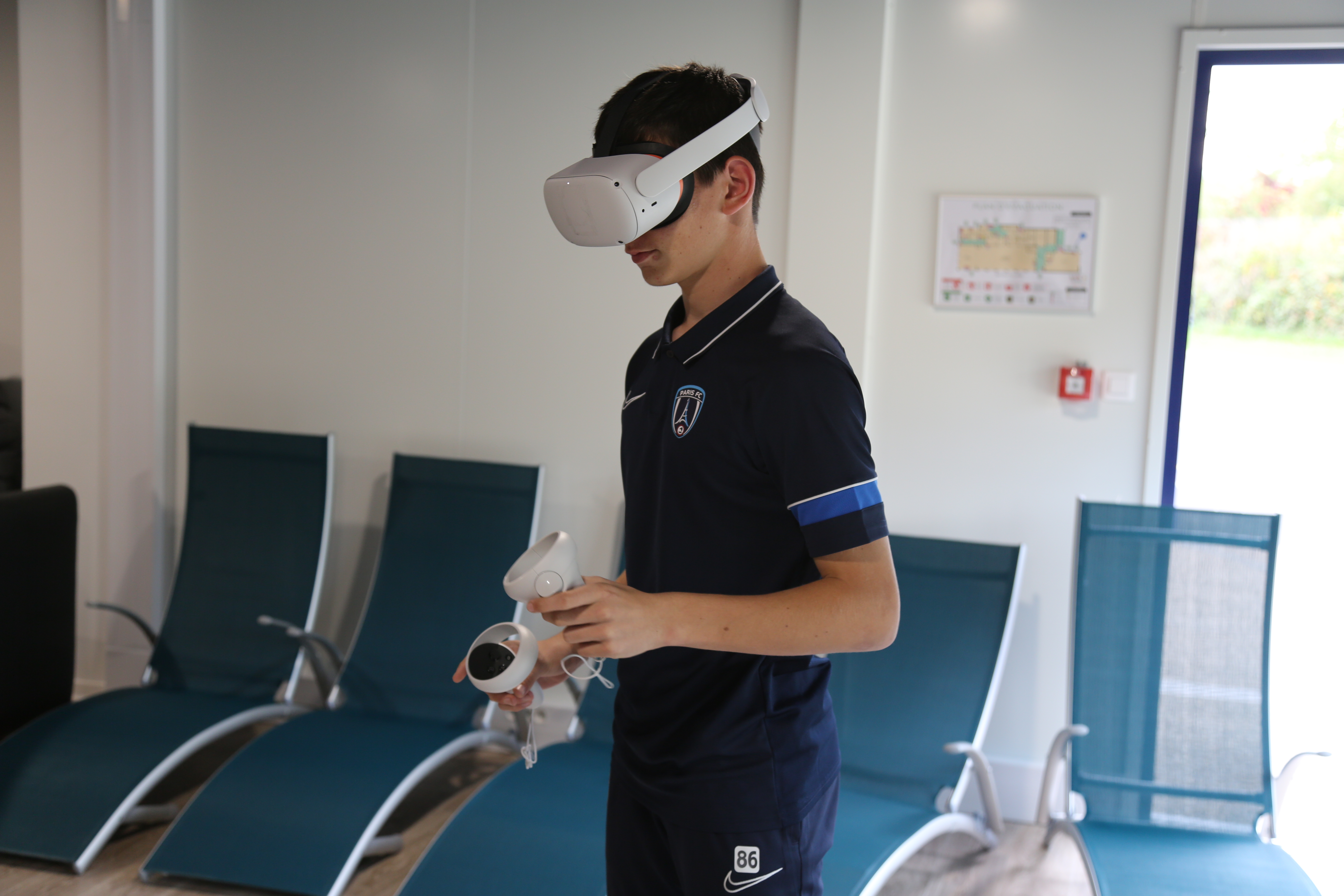
Our cognitive workshops in virtual reality are adapted from existing exercises

Our goal: to provide precise, quantified data that these exercises, practised empirically, did not previously allow us to obtain.

CO-DESIGN

University of Lille

Co-design of our cognitive assessment protocol based on standardised exercises from the scientific literature. Study conducted on a representative multi-sport panel of male and female athletes.

CLINICAL STUDY

CERS Capbreton

Study conducted on shoulder rehabilitation protocols 60 days post-surgery. The cohort consisted of 60 individuals, comprising a control group and a group using the solution.

FINANCIAL SUPPORT

Région Nouvelle-Aquitaine

Financial support from the region after being selected for the UNITEC-SPORTEC program. Our first prototypes were developed thanks to a partnership established with the PAU FC club.

ACADEMIC PARTNERSHIP

EPFL

Research partnership to validate and evolve our virtual reality cognitive training protocols.

Our consultants

Experts who guarantee the clinical and scientific rigour of every PerforMind protocol.

Scientific bibliography

The research work our protocols are based on.
Construct validity of the Trail Making Test: role of task-switching, working memory, inhibition/interference control, and visuomotor abilities
Sánchez-Cubillo, I., Periáñez, J. A., Adrover-Roig, D., Rodríguez-Sánchez, J. M., Ríos-Lago, M., Tirapu, J. E. E. A., & Barceló, F. (2009) · Journal of the International Neuropsychological Society, 15(3)
Auditory SR compatibility: the effect of an irrelevant cue on information processing
Simon, J. R., & Rudell, A. P. (1967) · Journal of applied psychology, 51(3)
Influence of different paths on spatial memory performance in the block-tapping test
Smirni, P., Villardita, C., & Zappalá, G. (1983) · Journal of Clinical and Experimental Neuropsychology, 5(4)
Video games and spatial cognition
Spence, I., & Feng, J. (2010) · Review of general psychology, 14(2)
Incomplete psychometric equivalence of scores obtained on the manual and the computer version of the Wisconsin Card Sorting Test?
Steinmetz, J. P., Brunner, M., Loarer, E., & Houssemand, C. (2010) · Psychological Assessment, 22(1)
Conditional accuracy in response interference tasks: Evidence from the Eriksen flanker task and the spatial conflict task
Stins, J. F., Polderman, J. T., Boomsma, D. I., & de Geus, E. J. (2008) · Advances in cognitive psychology, 3(3)
Trail Making Test A and B: normative data stratified by age and education
Tombaugh, T. N. (2004) · Archives of clinical neuropsychology, 19(2)
Automatic and controlled response inhibition: associative learning in the go/no-go and stop-signal paradigms
Verbruggen, F., & Logan, G. D. (2008) · Journal of experimental psychology: General, 137(4)
1 2 3 4
PerforMind

READY TO PUSH YOUR LIMITS?

Let's talk about your organization and your goals. Our team supports you from A to Z. Enjoy a free one-month trial.